Knowledge Base & Wiki
Outline
Rest of world Report an errorPanel rating · 6 judges · How to read the stars
Category median
Sovereignty: 1 of 6 dimensions proven
0–5 in half steps. 5 means the rubric's top anchor is met on the evidence.
by General Outline, Inc. · www.getoutline.com
Report an error on this page Is this your product? →
Link to this page

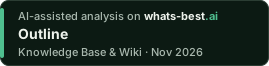
Add ?theme=dark to the image address for dark backgrounds.
The badge shows the category and the month of the latest evaluation, and EU-Made where
that is the product’s provenance. It never shows a score.
Outline at a glance
- Vendor
- General Outline, Inc.
- Headquarters
- Incorporated in United States source, captured 1 Nov 2026
- Data hosting
- Not stated on the vendor’s pages as of 1 Nov 2026
- Free plan
- Not stated on the vendor’s pages as of 1 Nov 2026
- Panel verdict
- The AI panel rates Outline 2.5/5, the mean of 6 judges. Outline is a team knowledge base from General Outline, Inc., a Delaware corporation. how scores are made
- As of
- Vendor pages captured 1 Nov 2026; evaluated by the panel 1 Nov 2026. all sources
Read this page as one judge. Each weighs the same scores by what they care about.
The panel's verdict
Outline is a team knowledge base from General Outline, Inc., a Delaware corporation. The strongest marks go to portability and hosting, authoring and search and publishing and integrations (a flat 6). The pages document a Markdown editor with real-time co-editing and a broad embed catalogue, workspace search with AI answers, an API with client libraries, signed webhooks, Zapier, Make and a built-in MCP server. Self-hosting on Docker or from source is documented, with importers for Confluence, Notion and Slab and export that stays open through the read-only period after the 30-day trial. The weakest area is knowledge governance: beyond revision history and an audit log, we found no public information on page owners, review dates, approval workflows or read confirmations. Access control scores 5–6, with no public information on SCIM or enforced two-factor authentication. Sovereignty scores 4–5 — primary processing takes place in the United States, all thirteen published subprocessors are US or Canadian, and we found no public information on an EU hosting option. Score spreads never exceed one point.
Speaks for it
- Authoring and search scored 6–7 on a Markdown editor with real-time co-editing, comments and threads, templates, backlinks and a broad embed catalogue for diagrams and code services.
- Publishing and integrations holds a uniform 6 for an API with an OpenAPI specification, client libraries, signed webhooks, Zapier, Make, Slack search and a built-in MCP server.
- Portability and hosting scored 6–7, with importers for Confluence, Notion and Slab, export open through the read-only period after the 30-day trial, and documented self-hosting on Docker or from source.
- A published data processing agreement carries EU and UK standard contractual clauses, names thirteen subprocessors, and states deletion at the customer's choice.
- Single sign-on through Google Workspace, Microsoft Entra ID and OpenID Connect providers is documented, alongside read and write permissions, user groups and guest users.
Held against it
- Knowledge governance scored 3–4 — the bench's lowest range — with no public information on page owners, review dates with reminders, approval workflows or read confirmations.
- Access control scored 5–6, with no public information on SCIM, LDAP directory sync, enforced two-factor authentication or IP and domain restrictions.
- Sovereignty scored 4–5: primary processing takes place in the United States, all thirteen published subprocessors are US or Canadian, and we found no public information on an EU hosting option.
- We found no public information on help-center SEO controls, an in-product widget, multilingual publishing or help-desk ticket deflection.
- Self-hosting requires dev-ops experience, some features are marked Business and Enterprise only, and the export format and whether history travels with it are not stated on the pages.
Best for
- Your engineering or product team writes in Markdown and wants live embeds for diagrams, whiteboards and code services with workspace search and AI answers.
- You build automation on the knowledge base through the API, webhooks, Zapier, Make or the built-in MCP server for AI assistants.
- You want a documented exit and hosting choice: Confluence, Notion and Slab importers, export after the trial, and self-hosting on Docker or from source.
- Your team works from Slack, where the /outline command searches the knowledge base and notifications can route by collection.
Avoid if
- Your quality or certification regime requires named page owners, review schedules, approvals and read confirmations — knowledge governance scored 3–4, the bench's lowest range.
- You require an EU hosting option for the cloud service; the captured pages state primary processing takes place in the United States and we found no public information on an EU option.
- Your identity requirements include SCIM, LDAP directory sync or enforced two-factor authentication — we found no public information on these, and the integration pages mark OpenID Connect sign-on as self-hosted availability.
- You are buying primarily as a customer-facing help center — publishing and integrations scored 6 and we found no public information on SEO controls, an in-product widget, multilingual publishing or ticket deflection.
The scores
| Criterion | Panel median |
|---|---|
| Editor, structure & search | 3 of 5 |
| Verification, ownership & freshness | 2 of 5 |
| Permissions, SSO & administration | 3 of 5 |
| Help-center publishing & integrations | 3 of 5 |
| Import, export & self-hosting | 3.5 of 5 |
| European sovereignty | 2 of 5 |
Verification, ownership & freshness
Show reasoningHide reasoning
How this is scored
Whether the content stays true: page owners or experts named per page, verification with a review date and a reminder when it lapses, approval or publishing workflows with drafts and reviewers, read confirmations for mandatory pages, analytics on views, searches without a result and stale pages, duplicate detection, archiving rules, and an audit trail of who changed and approved what.
0 — No way to see who owns a page or when it was last checked beyond the edit date.
3 — Page history and last-edited dates; owners, verification, approvals and content analytics are basic or not described.
5 — An owner or verifier per page, a review interval with reminders, a draft and publish step, page view statistics, and archived pages kept out of search.
8 — Approval workflows with several reviewers, read confirmations for mandatory pages, analytics on failed searches and stale content, duplicate or outdated content flagged automatically, and an exportable audit trail of changes and approvals.
10 — Governance that a regulated organisation runs on: controlled documents with versioned approvals that meet a named standard (ISO 9001, GxP), expiry and review enforced per space, knowledge gaps reported from searches and AI questions, and every published statement traceable to an approved version.
The Operations Lead
Revision history, a security audit log that tracks and filters edits and user activity, and view and event analytics piped to Google Analytics, Matomo or Umami are documented. But nothing on the captured pages names a page owner or verifier, a review interval with reminders, approval workflows, read confirmations or stale-page flagging — and for a company that wants every page to say who keeps it current, that is the decisive gap. 3 5 2
The IT Administrator
Revision history and a security audit log tracking edits and user activity are documented, and the guide lists Governance and Insights sections by name. We found no public information on page owners, review intervals with reminders, approval workflows, read confirmations or stale-content analytics, which is thin for a regulated organisation like ours. 3 5
The Support Knowledge Manager
Revision history, a security audit log of edits and user activity, and view analytics sent to Google Analytics, Matomo or Umami are documented. We found no public information on named page owners, review dates with reminders, approval or read-confirmation workflows, or analytics on searches that return nothing, which is exactly how I keep a knowledge base honest. 2 3 5
The Engineering Lead
Revision history on documents and a security audit log that tracks and filters edits and user activity are documented, and the admin area names Insights and Governance sections. We found no public information on named owners or verifiers per page, review dates with reminders, approval or draft-to-publish workflows, read confirmations, or analytics on stale, duplicate or failed searches — the parts a regulated team would actually run verification on. 5 3
The Quality Manager
Revision history is documented, a security audit log tracks and filters edits and user activity, and view analytics can be sent to Google Analytics, Matomo or Umami. We found no public information on named page owners, review dates with expiry and reminders, approval workflows with reviewers, or read confirmations for mandatory documents — the controlled-document features a certified supplier needs. 3 2 5
The Skeptic
Page-level governance is thin: revision history and an audit log of edits and user activity are described, and view analytics can be piped to Google Analytics, Matomo or Umami. We found no public information on page owners, verification or review dates, approval workflows, read confirmations, or analytics on failed searches and stale content. 3 5 2
Permissions, SSO & administration
Show reasoningHide reasoning
How this is scored
Who may see and edit what, and how the administrator keeps control: roles and permissions per space and per page, restricted or private pages, guest and external access, groups synced from Azure AD/Entra ID, Google Workspace or LDAP, single sign-on (SAML, OIDC), SCIM provisioning, two-factor authentication enforced, an audit log of access and permission changes, and admin controls over sharing and public links. Where the data is hosted and certifications are scored under sovereignty.
0 — Everyone in a workspace sees and edits everything; no permissions of any kind.
3 — Admins, members and guests, or private and shared pages; per-space or per-page rights, SSO and an audit log are basic or not described.
5 — Permissions per space and per page, guest access with limits, single sign-on through Google or Microsoft, two-factor authentication, groups, and admin control over public sharing.
8 — SAML or OIDC single sign-on with any identity provider, SCIM provisioning or LDAP and directory group sync, enforced 2FA, an audit log of views, edits and permission changes, IP or domain restrictions, and permissions honoured by search and AI answers.
10 — Access control an enterprise auditor accepts as documented: granular roles with inheritance explained, just-in-time and external access with expiry, every access and permission change logged and exportable to a SIEM, and the permission model published with its limits.
The Operations Lead
Read and write permissions with user groups and guest users, sign-in through Google Workspace, Microsoft Entra ID, Discord and Slack, and single sign-on with any OpenID Connect provider such as Okta, Auth0 or Keycloak are documented, alongside users and roles, groups and an audit log in administration. We found no public information on SAML, SCIM or directory group sync, enforced two-factor authentication, or an audit of permission changes; the integrations pages also mark the OpenID Connect option as self-hosted availability, which a cloud buyer should check. 1 2 3 5 12
The IT Administrator
Read and write permissions, user groups, guest users and controls over public sharing are documented, with sign-in through Microsoft Entra ID, Google Workspace, and OpenID Connect for any identity provider. We found no public information on directory group sync, SCIM provisioning, enforced two-factor authentication, or whether the audit log records permission changes, which is what our auditor will ask about. 1 2 3 5
The Support Knowledge Manager
Read-and-write permissions with user groups, guest users and controlled public sharing are documented, as are single sign-on through Google Workspace and Microsoft Entra ID, OpenID Connect sign-in with providers such as Okta, Auth0 and Keycloak as a self-hosted option, and an audit log of workspace activity. We found no public information on SCIM or LDAP provisioning, enforced two-factor authentication, or IP and domain restrictions. 1 2 3 5
The Engineering Lead
Read and write permissions, user groups and guest users are documented, with sign-in through Google Workspace, Microsoft Entra ID and any OpenID Connect provider including Okta, Auth0 and Keycloak, plus a security audit log. We found no public information on SCIM provisioning, LDAP or directory group sync, enforced two-factor authentication, or IP and domain restrictions, which is what our auditors would ask for next. 1 2 3 5
The Quality Manager
Read and write permissions with user groups and guest users are documented, alongside single sign-on through Google Workspace, Microsoft Entra ID and any OpenID Connect identity provider such as Okta or Keycloak, plus a users-and-roles administration area and an audit log. We found no public information on enforced two-factor authentication, SCIM or LDAP directory sync, or IP and domain restrictions. 1 2 3 5
The Skeptic
Read and write permissions, user groups, guest users, control over public sharing, an audit log, and single sign-on through Google Workspace, Microsoft Entra ID and OpenID Connect providers are all documented. For a higher mark I would want SCIM or LDAP directory sync, enforced two-factor, IP or domain restrictions, and a statement that search and AI answers honor the permissions. 1 2 3 5
Help-center publishing & integrations
Show reasoningHide reasoning
How this is scored
How knowledge reaches people outside the editor: public or password-protected sites and help centers with a custom domain, branding and SEO controls, an in-app widget or contextual help, ticket deflection in a help desk, multilingual publishing, integrations with Slack, Microsoft Teams, Jira, Google Drive, help desks and CRMs, a browser extension, a documented REST or GraphQL API, webhooks, and an MCP server or connector for AI assistants.
0 — Content cannot be shared beyond the editor and nothing connects to it.
3 — Sharing a page by public link and a few integrations such as Slack; a branded help center, an API and webhooks are basic or not described.
5 — A published site or help center with custom domain and branding, integrations with Slack or Teams and Google Drive or Microsoft 365, a documented API, and embeds of common tools.
8 — A help center with SEO controls, multilingual publishing, access for logged-in customers and analytics, a widget or contextual help inside the customer's product, help desk integration with ticket deflection, webhooks, and a connector or MCP server for AI assistants.
10 — Knowledge delivered wherever it is needed from one source: internal and public audiences served from the same pages with per-audience rules, a complete API with SDKs and rate limits stated, a marketplace of integrations, and every channel measured in one report.
The Operations Lead
Public link sharing with a custom domain and white-label branding, a well-documented API with client libraries in five languages, an OpenAPI specification and stated rate limits, signed webhooks across document, collection and comment events, Zapier and Make, Slack search and notifications, and a built-in MCP server for Claude, ChatGPT and Cursor make the developer side of this strong. We found no public information on a branded help center with SEO controls, multilingual publishing, an in-product widget, or help-desk ticket deflection. 1 4 12 2 13
The IT Administrator
Public sharing on a custom domain with our branding, a documented API with stated rate limits, OAuth scopes and client libraries, signed webhooks, Slack integration including search from Slack, Zapier and Make, and a built-in MCP server for AI assistants are all evidenced. We found no public information on a help centre with SEO controls or multilingual publishing, a widget inside a product, or help-desk ticket deflection. 1 2 4 12 13
The Support Knowledge Manager
Public documents on a custom domain with own branding, Slack search and notifications, a thoroughly documented API with OAuth, an OpenAPI specification, client libraries and rate limits, signed webhooks, Zapier and Make, and a built-in MCP server for AI assistants give the integration side real depth. But we found no public information on an in-product help widget, help desk integration with ticket deflection, SEO controls, or help centers published in multiple languages — the channels my support team actually measures. 1 2 4 12 13
The Engineering Lead
The developer half is genuinely strong: an API that the main application itself is built on, with an OpenAPI specification, client libraries in five languages, OAuth2, documented rate limits, signed webhooks across document, collection and comment events, Zapier and Make, and a built-in MCP server for Claude, ChatGPT and Cursor. Documents can be shared publicly with custom branding and domain. We found no public information on help-center SEO controls, multilingual publishing, logged-in customer access, an in-product widget, or help-desk ticket deflection. 4 2 12 1 13
The Quality Manager
Documents can be shared publicly by link under a custom domain with own branding, Slack search and notifications are deeply integrated, dozens of services embed without configuration, and the API covers all data with client libraries, an OpenAPI specification, signed webhooks and a built-in MCP server for Claude, ChatGPT and Cursor. We found no public information on help-center SEO controls, an in-app widget, or ticket deflection in a help desk. 1 2 4 12 13
The Skeptic
Documents can go public on a custom domain with own branding, and the integration story is unusually strong: a documented API that powers the app itself with rate limits, client libraries and an OpenAPI spec, signed webhooks with automatic failure handling, Slack search from inside chat, Zapier and Make, and a built-in MCP server for AI assistants. We found no public information on a help center with SEO controls, multilingual publishing, customer-facing analytics or ticket deflection. 1 4 2 12 13
Import, export & self-hosting
Show reasoningHide reasoning
How this is scored
What arriving and leaving would cost: import from Confluence, Notion, Google Docs, Word and Markdown with structure, attachments and links kept, a full export of every space in an open format (Markdown, HTML, XML, PDF) with attachments and history, an API that reaches all content, a stated migration path from Confluence Server or Data Center, open-source code under a named licence, and a self-hosted or on-premise edition with its own documentation.
0 — Content cannot be imported or exported; it can only be read in the vendor's interface.
3 — Single pages export to PDF or Word and some files can be imported; a full export, a Confluence import and self-hosting are basic or not described.
5 — Import from Confluence or Notion and from Word or Markdown, a full workspace export to Markdown or HTML with attachments, a documented API covering pages, and a stated retention of data after cancellation.
8 — A Confluence migration tool or service that keeps hierarchy, permissions and attachments, a full export with history in an open format, a self-hosted or on-premise edition with installation and update documentation, and data returned or deleted on termination under stated terms.
10 — The customer owns the content end to end: open-source code under a named licence that runs fully self-hosted with feature parity stated, a complete export another tool can import without loss, and the deletion of every copy on termination documented.
The Operations Lead
A Confluence importer sits in the product guide alongside Notion import and Slab Markdown import, an export section is documented with the promise that all documents can be exported after the trial ends read-only, and the self-hosting documentation covers Docker, backups, SSL, file storage and horizontal scaling on infrastructure the customer owns — the company describes the codebase as permissively licensed. The data processing agreement states deletion at the customer's choice after the services end. The captured pages do not state the export format or whether history travels with it, nor the licence terms for the self-hosted Business and Enterprise features. 5 2 3 6 7 10
The IT Administrator
A Confluence importer and export are documented, and the self-hosting guide covers Docker and from-source installation, backups, SSL, Redis, file storage and horizontal scaling, with personal-data deletion on termination under the data processing agreement. We found no public information on whether the Confluence import keeps hierarchy, permissions and attachments, or on the export format and history, and some self-hosted features are marked Business and Enterprise only. 5 6 7 10
The Support Knowledge Manager
Importers for Confluence, Notion with images and attachments, and Slab Markdown are documented, all documents can be exported including during the read-only period after the trial, the API reaches all data, and the self-hosted edition comes with installation and configuration documentation for Docker, file storage, backups and scaling, though the vendor says devops experience is required. We found no public information on the export format or whether history is included, and the self-hosted edition documents licence restrictions with some features reserved for Business and Enterprise. 2 3 4 5 6
The Engineering Lead
Self-hosting is documented in earnest — Docker, from source, backups, file storage, SSL and horizontal scaling, with a fair warning that production needs dev-ops experience — and importers exist for Confluence, Notion and Slab Markdown exports, with the 30-day trial explicitly keeping export of all documents open. The data processing agreement states deletion at the customer's choice once the service ends. We found no public information on the export format, whether the Confluence import keeps hierarchy and permissions, or a named licence with stated feature parity; some features are marked cloud-only and others Business and Enterprise only when self-hosting. 6 5 3 10 2 1
The Quality Manager
Importers exist for Confluence, Notion with attachments, and Slab Markdown, documents can be exported in full even in the read-only period after trial, and the API reaches all content. Self-hosting is documented for Docker and from source with configuration, backup and scaling guidance on largely public, permissively licensed code, with deletion on request under the DPA; we found no public information on export formats and history, or full self-hosted parity beyond notes that some functions are cloud-only and some Business/Enterprise-only. 2 3 5 6 7 10
The Skeptic
Importers exist for Confluence, Notion and Slab exports, the API is stated to reach all data, and self-hosting is real with Docker installation, scaling, backups and licence-restriction documentation, while the trial leaves the base read-only but exportable until payment. What leaving would actually cost is unstated: the captured pages never say what a full export contains — format, attachments, history — and we found no migration service and no data-return terms beyond personal-data deletion in the processing agreement. 2 3 4 5 6 10
European sovereignty
panel opinion
Show reasoningHide reasoning
How this is scored
Who the contracting entity and the parent company are, where pages, attachments and search indexes are stored and processed, and who the subprocessors are (hosting, CDN, search, email, support, payment, and the AI model provider that reads pages for answers and summaries, with whether content is used for training). Independently sourced by the sovereignty pipeline; a wiki holds internal processes, customer data and trade secrets, so the whole chain counts, not only the database. A self-hosted or open-source edition the customer runs on its own European servers counts as the customer's chain, whatever the vendor's seat.
0 — Non-EU vendor and contracting entity, hosting unstated, subprocessors unnamed, and no data processing agreement offered.
3 — A privacy policy and a data processing agreement exist, but hosting location is unstated or non-EU and the subprocessors are not listed.
5 — EU data residency available and an EU contracting entity or EU representative, but parts of the chain (CDN, search, email, support, AI model) run through non-EU providers without a stated safeguard, or EU residency is limited to the higher tiers.
8 — EU hosting on named infrastructure, EU contracting entity, subprocessors listed with their locations including the AI model provider, no training on customer content stated, a data processing agreement published, and security certifications (ISO 27001, SOC 2) stated — or a self-hosted edition documented that keeps every page on the customer's own servers.
10 — Sovereign end to end and evidenced: European ownership, entity, hosting and every subprocessor including AI, or a self-hosted open-source edition with no call home, data export and deletion documented, and certifications published with their scope rather than implied.
The Operations Lead
The contracting entity is General Outline, Inc., a Delaware corporation in New York, whose agreement states that primary processing takes place in the United States; the published data processing agreement names thirteen subprocessors — hosting on AWS, Fly.io and Heroku, Cloudflare for content delivery, Mailgun for email, Help Scout for support, Stripe for billing and OpenAI for generative AI — almost all in the United States, with the 2021 EU standard contractual clauses as the transfer safeguard. A self-hosted edition with full installation documentation exists, but the captured pages state no EU data residency option for the cloud service, and we found no public information on security certifications or on whether customer content is used for AI training. 10 6 7
The IT Administrator
A data processing agreement is published with the 2021 EU standard contractual clauses and a full subprocessor list, but the contracting entity is a Delaware corporation, primary processing takes place in the United States, and every named subprocessor including OpenAI for generative AI is US or Canadian; we found no EU residency option on the captured pages. The documented self-hosted edition is what would let us keep every page on our own European servers if the works council or regulator asks. 6 7 10
The Support Knowledge Manager
The contracting entity is a Delaware corporation, primary processing takes place in the United States, and the published subprocessor list places hosting, CDN, email, support, billing and generative AI (OpenAI) with US providers, one in Canada. A data processing agreement with EU and UK standard contractual clauses, deletion at the customer's choice, and a documented self-hosted edition are positives, but we found no public information on EU data residency, security certifications, or a commitment that customer content is not used for model training, and self-hosting requires devops experience under licence restrictions. 6 7 9 10
The Engineering Lead
The contracting entity is General Outline, Inc., a Delaware corporation, primary processing is stated to take place in the United States under Californian governing law, and the published subprocessor list runs almost entirely through US providers — AWS, Cloudflare, Mailgun, Stripe, and OpenAI for generative AI — though a data processing agreement with EU and UK standard contractual clauses is published and subprocessor locations are listed. We found no public information on an EU hosting option for the cloud service; the documented self-hosted edition is the one route to a European chain, and we found no public information confirming it keeps every page on our own servers with no external calls. 10 9 6 1
The Quality Manager
The contracting entity is General Outline, Inc., a Delaware corporation, primary processing takes place in the United States, and every listed subprocessor — including hosting on AWS, Fly.io and Heroku, Cloudflare, Mailgun, Help Scout, Stripe and OpenAI for generative AI — is US or Canada, under California law with EU standard contractual clauses in a published DPA. A documented self-hosted edition on permissively licensed code can keep pages on a European customer's own servers, but we found no public information on an EU hosting option, a no-training commitment, or ISO 27001/SOC 2 certifications. 7 9 10
The Skeptic
The chain is American end to end — a Delaware corporation under California law, primary processing in the United States, subprocessors led by Amazon Web Services and Cloudflare, and OpenAI named as the generative-AI provider reading the pages (one subprocessor sits in Canada) — though at least the whole list is published with a processing agreement carrying the 2021 EU standard contractual clauses. There is no EU residency option, no European contracting entity, no statement on training with customer content and no security certifications; the self-hosted edition, while documented, carries licence restrictions and edition-gated features I cannot treat as a sovereign escape hatch. 9 10 5 6 7
Pricing transparency
not rated — the vendor publishes no price
Show reasoningHide reasoning
How this is scored
Whether a buyer can compute the real annual cost from public pages alone: price per user and tier, readers or guests free or charged, minimum seats, which features (SSO, SCIM, audit log, verification, help-center publishing, custom domain, AI answers, EU data residency) cost extra, the free tier and its limits, storage limits, the self-hosted edition's licence and support price, minimum term and setup or migration fees.
0 — No public prices at all; every customer is a sales call.
3 — A starting price or a free tier exists, but how cost scales with users, readers or features is unclear.
5 — Tiers are public with their price per user and main inclusions, but at least one commonly needed piece (SSO, AI, readers or guests, EU residency, the self-hosted edition) is unpriced or "on request".
8 — Every tier priced publicly with its scaling rule (editors, readers, guests, storage), add-ons priced, the self-hosted edition's licence and support cost stated, minimum seats, term and VAT treatment stated.
10 — Complete price computability: annual cost derivable for a given number of editors and readers and a feature set, with every add-on, AI credit, setup, migration and support fee and the cancellation and data-return terms published.
The Operations Lead
Three tiers are published at "$10 per month", "$79 per month" and "$249 per month" for team sizes of one to ten, eleven to one hundred and one hundred and one to two hundred members, with automatic movement to the next tier, a thirty-day free trial that turns read-only, and a thirty percent discount for non-profit and education — for my one hundred and eighty people the figure is visible without a sales call. But the captured pages give no per-tier feature breakdown, no price for guests or read-only readers, AI answers or the self-hosted Business and Enterprise editions, no storage limits or term conditions, and teams above two hundred members are asked to contact the vendor for pricing. 3 6
The IT Administrator
Three cloud tiers are public at $10, $79 and $249 per month for teams up to 200 members, with annual pricing, a 30-day trial that leaves the workspace read-only with export allowed, and a 30% non-profit and education discount. For a team of our size the pricing page says to contact them about teams larger than 200 users, and we found no public prices for the self-hosted edition's licence and support, or for guest and reader access. 3 6
The Support Knowledge Manager
The pricing page publishes three tiers at "$10 per month", "$79 per month" and "$249 per month" for teams of 1–10, 11–100 and 101–200 members, with automatic tier changes, a 30-day free trial that keeps export available, a 30% non-profit and education discount, and contact-us pricing above 200 users. We found no public information on the licence or support price of the self-hosted Business and Enterprise editions, guest or reader seats, storage limits, minimum term or VAT treatment. 3 6
The Engineering Lead
Three cloud tiers are published — "$10 per month" for 1–10 members, "$79 per month" for 11–100 and "$249 per month" for 101–200 — with annual pricing available, automatic moves to the next tier as the team grows, and SSO, templating, the audit log and API plus webhooks listed among the features. Beyond 200 members the pricing page says to contact them, and we found no public information on guest or reader charges, storage limits, minimum term, VAT, or the self-hosted edition's licence and support cost. A 30% discount for non-profit and education and a free 30-day trial that stays exportable are stated. 3 6
The Quality Manager
The pricing page publishes three tiers at $10, $79 and $249 per month for teams of 1–10, 11–100 and 101–200 members, with automatic tier moves, annual pricing, a 30-day free trial and a 30% non-profit and education discount; teams above 200 members must contact the vendor. We found no public information on which features sit in which tier, guest or reader charges, storage limits, or the licence and support cost of the self-hosted edition. 3
The Skeptic
Three public tiers priced by team size — "$10 per month", "$79 per month", "$249 per month" for 1–10, 11–100 and 101–200 members — plus automatic re-tiering, a 30-day free trial that ends read-only but exportable, and a 30% non-profit and education discount are all on the pricing page. Above 200 members the price becomes a conversation, and we found no public price for the self-hosted Business and Enterprise editions, no storage limits, no VAT or term treatment, and no word on whether guests or readers are billed at all. 3 6
European sovereignty — proven facts
1 of 6 dimensions provenBuilt only from facts shown on the vendor's own pages. A dimension we could not prove is left open, not scored as zero.
| Legal entity | Incorporated in US | 0/2 pts | 10 Report an error |
|---|---|---|---|
| Hosting location | Not determined ⚠ unverified | — | uncited Report an error |
| Hosting options | Not determined ⚠ unverified | — | uncited Report an error |
| Open source | Not determined ⚠ unverified | — | uncited Report an error |
| Data processing agreement | Not determined ⚠ unverified | — | uncited Report an error |
| Transfer impact assessment | Not determined | — | uncited Report an error |
Questions about Outline
Is Outline European?
No. whats-best.ai classifies Outline as Rest of world. Its vendor, General Outline, Inc., is incorporated in United States, per the vendor’s page captured 1 Nov 2026.
Where does Outline store data?
Not stated on the vendor’s pages as of 1 Nov 2026.
Does Outline have a free plan?
Not stated on the vendor’s pages as of 1 Nov 2026.
What are the best alternatives to Outline?
As of 1 Nov 2026, the panel rates Document360 (3.5/5), BookStack (3/5) and XWiki (3/5) highest among the other 13 Knowledge Base & Wiki products evaluated. Ratings that look equal are rounded to half stars; the order uses the unrounded rating, then the name. The highest-rated European alternative is Document360 (UK / wider Europe). Ratings are the AI panel’s opinion, formed from public evidence: how scores are made. The full list, with European products first: Outline alternatives.
Where this could be wrong
- Evidence ages. The oldest capture behind this page is from 1 Nov 2026. Vendors change pricing and policies without notice; every fact reflects its source as of the capture date shown in the registry.
- Weak sourcing — Open source, Hosting location, Hosting options, Data processing agreement. Not confirmed on the vendor’s own pages as captured.
- AI can misread a source. Extraction and judgement are automated; a citation guarantees traceability, not infallibility. If something here is wrong, say so — no account needed, every report is decided within 5 business days, and accepted corrections are published.
What we left out
A claim that does not survive our checks costs us the claim, not the page. This is what was taken off this one.
- 12 legal facts could not be confirmed on the vendor’s page as captured and were left out of this page and of the panel’s material. Know more? Tell us
- 6 product facts could not be confirmed on the vendor’s page as captured and were left out of this page and of the panel’s material. Know more? Tell us
- 5 integrations facts could not be confirmed on the vendor’s page as captured and were left out of this page and of the panel’s material. Know more? Tell us
- 2 compliance facts could not be confirmed on the vendor’s page as captured and were left out of this page and of the panel’s material. Know more? Tell us
- 4 sovereignty dimensions could not be confirmed on the vendor’s own pages and are shown as unknown. Know more? Tell us
- 6 of the readings below were written against an earlier fact sheet — a fact has been corrected, added or pulled since. Until the panel next runs on this product you are reading the older judgement. Know more? Tell us
Sources (15)
The pages every claim on this page was read from — each one checked, dated, and kept verifiable.
- 1 Vendor homepage www.getoutline.com Checked 1 Nov 2026 Details →
- 2 Integrations page www.getoutline.com Checked 1 Nov 2026 Details →
- 3 Pricing page www.getoutline.com Checked 1 Nov 2026 Details →
- 4 API documentation www.getoutline.com Checked 1 Nov 2026 Details →
- 5 Documentation (product guide) docs.getoutline.com Checked 1 Nov 2026 Details →
- 6 Documentation (self-hosting) docs.getoutline.com Checked 1 Nov 2026 Details →
- 7 About page www.getoutline.com Checked 1 Nov 2026 Details →
- 8 Privacy policy www.getoutline.com Checked 1 Nov 2026 Details →
- 9 Terms of service www.getoutline.com Checked 1 Nov 2026 Details →
- 10 Data processing agreement (dpa) docs.getoutline.com Checked 1 Nov 2026 Details →
- 11 Editor, structure & search — found from sitemap www.getoutline.com Checked 1 Nov 2026 Details →
- 12 Help-center publishing & integrations — found from sitemap www.getoutline.com Checked 1 Nov 2026 Details →
- 13 Help-center publishing & integrations — found from sitemap www.getoutline.com Checked 1 Nov 2026 Details →
- 14 Import, export & self-hosting — found from sitemap www.getoutline.com Checked 1 Nov 2026 Details →
- 15 Code repository (open-source licence) — found from the homepage github.com Checked 1 Nov 2026 Details →